 iORbase 2.0 - Comprehensive Analysis Platform for Insect odorant Receptors
iORPred - iOR Function Prediction
The prediction model is currently under further optimization and debugging. An online prediction interface will be provided in future version updates.
We propose a transfer learning-based iOR function prediction strategy aimed at addressing the bottlenecks of sparse experimental data and cross-species generalization difficulties.
Two-Step Prediction Strategy
The strategy consists of two steps: First, the deep learning model is pre-trained using large-scale molecular docking data (approximately 6 million interactions recorded in the DockingSet module), enabling it to grasp the overall distribution of binding features between ORs and VOCs.
Subsequently, fine-tuning is performed on limited high-quality experimental data (from species such as Drosophila and Anopheles, already collected in the iORExp module), allowing the model to adapt to real biological response patterns. Through this approach, the model effectively combines the breadth of virtual screening with the precision of experimental data.
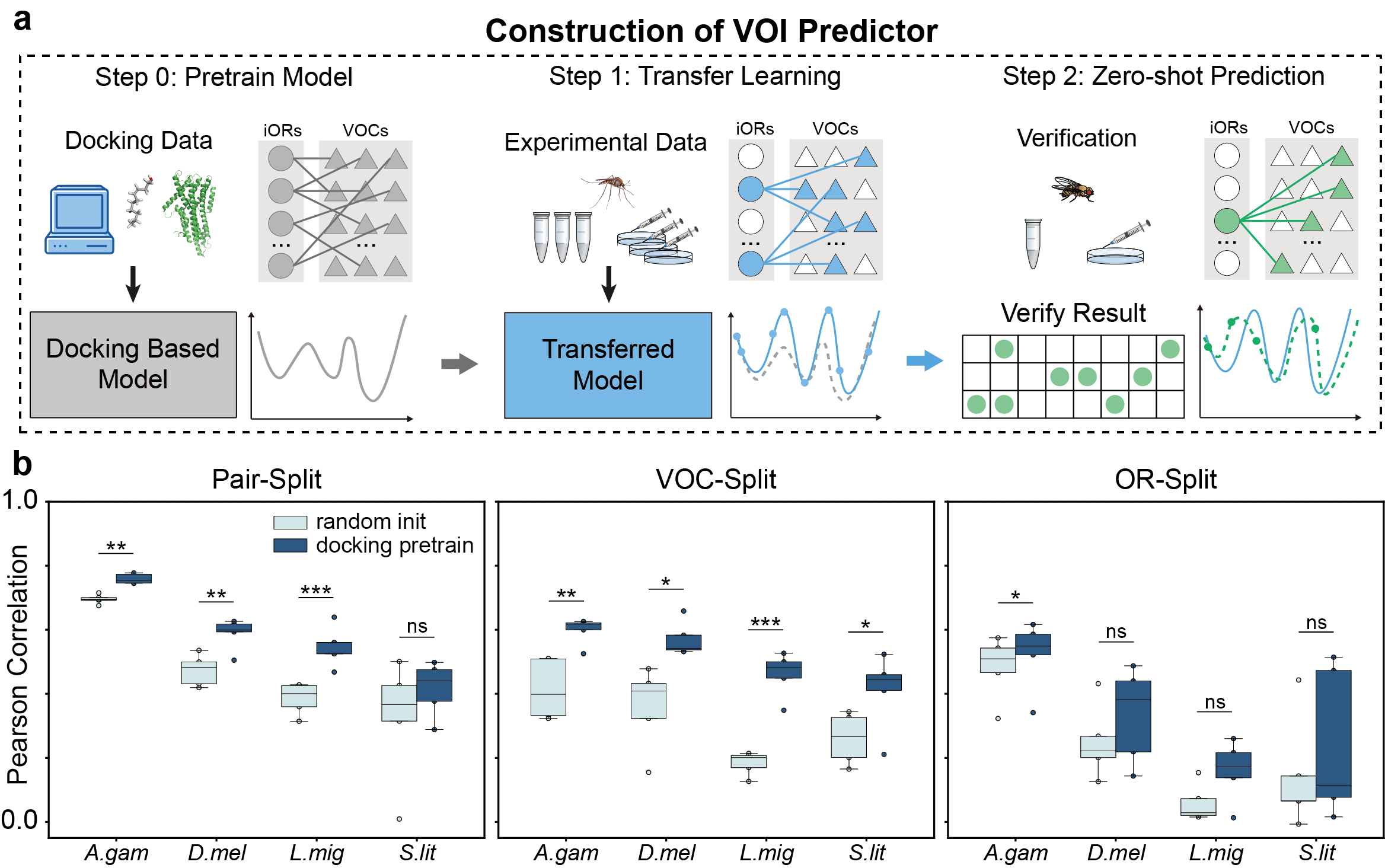
Figure 1. a: Transfer learning strategy; b: Model performance comparison (Transfer learning vs Random initialization)
Model Performance Validation
Validation on multiple independent test sets demonstrates that the transfer learning model significantly outperforms the randomly initialized baseline model in both in-distribution (random split) and out-of-distribution (unseen VOC) prediction tasks. The Pearson correlation coefficient between predicted and true results exceeds 0.5 in most datasets, reaching up to 0.8.
More importantly, we conducted functional experimental validation using an independent pest species, Bactrocera dorsalis. Results showed that the positive hit rate from model predictions in the top predictions can reach 2 times the random level (enrichment factor = 2), confirming its cross-species prediction capability.
Key Finding: The transfer learning model achieves Pearson correlation coefficients exceeding 0.5 in most datasets (up to 0.8), with an enrichment factor of 2 in cross-species experimental validation.
Applicability Scope
Currently, the reliable application scope of this model is limited to Diptera insects. Cross-order predictions remain challenging. With the accumulation of experimental data in the future, the generalization ability of the model is expected to further expand.
Related Resources
📄 Paper preprint published on bioRxiv: https://doi.org/10.64898/2026.07.03.736362
💻 Model code and usage scripts are open-sourced on GitHub: https://github.com/iORbase/insectOlf